A coordinated dual-vessel cycle
One vessel fills while the other transfers. Coordinated switching supports continuous upstream feeding within the engineered duty.

Generation 5 modular skid
An integrated skid combines twin vessels, valves, instruments, pipework and the control cabinet. The aim is simpler site integration and dependable automatic operation.
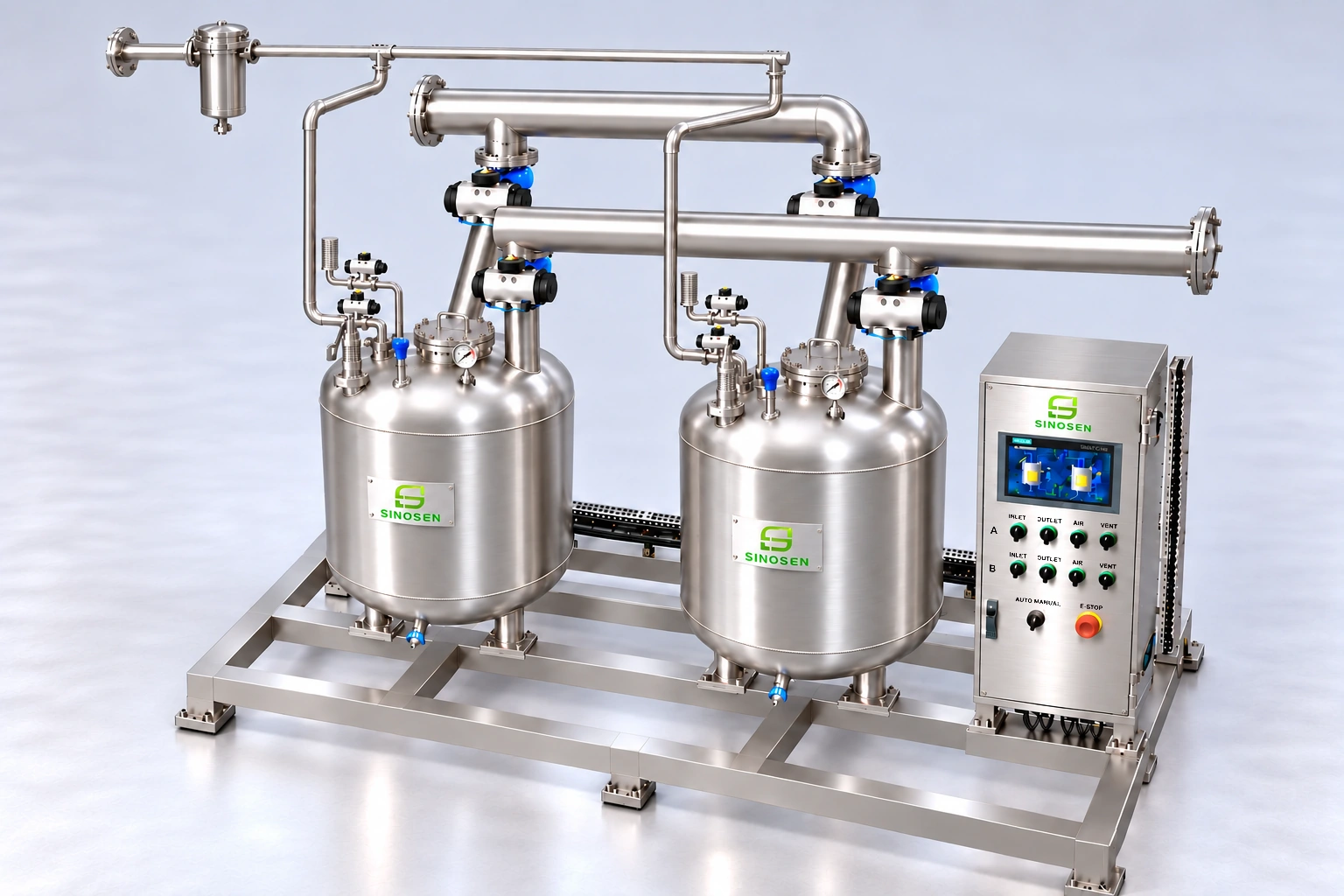
One vessel fills while the other transfers. Coordinated switching supports continuous upstream feeding within the engineered duty.
Vessels, valves, instruments, pipework and control cabinet arrive assembled on a common frame for the agreed skid package.
The sequence and agreed interfaces are checked before dispatch. Defined site connections and remote support simplify start-up.
A suitable A/B arrangement can continue at reduced capacity with one vessel isolated. Level and time modes support an agreed fallback strategy.
Select hygienic or industrial construction, stainless steel grade, insulation, vacuum-assisted filling and an optional CIP module.
THE GENERATION 5 PRINCIPLE
Follow the alternating cycle. Compressed air moves the liquid; the PLC manages filling, isolation, discharge and venting.
Vessel A receives product while vessel B transfers to the receiver. Upstream and downstream permissives govern the cycle.
The full vessel is isolated before pressurization. The empty vessel vents through the specified arrangement before refilling.
The PLC exchanges the roles of the vessels. Vessel A transfers while vessel B fills, subject to the agreed permissives.
The emptied vessel A vents while vessel B prepares to transfer. The cycle repeats; actual timing depends on the product, route and available air.
Approve the duty, layout, piping connections, utilities, receiver arrangement and upstream/downstream permissives before fabrication.
Check the agreed skid assembly, instruments, valve operation and control sequence against the factory acceptance plan.
Qualified local installers complete the foundation, product piping, power, compressed air, venting and agreed signal wiring.
Complete site safety checks, leak checks, interlock tests and product trials. Confirm the operating recipe with SINOSEN remote assistance or the agreed service scope.
The skid is preassembled and factory-tested to reduce site assembly and tuning. The site still provides the foundation, product pipes, power, compressed air, vent arrangement and agreed control interfaces. Local checks and commissioning acceptance remain necessary.
Alternating vessels can support continuous feeding and reduce transfer interruptions. Instantaneous outlet flow is not automatically constant. Valve transitions, air supply, pipeline resistance and receiver design must be evaluated for the required flow profile.
It removes the rotating pump element and its shaft-seal maintenance. Valves, seats, instruments, filters, pressure protection and the vessel still require planned inspection and service.
Options are selected during engineering; inclusion depends on the agreed scope.
| Option | Selection basis |
|---|---|
| Insulated vessel | Stainless outer cladding with a specified insulation system. Review heat retention, external temperature, moisture protection and inspection access. |
| Vacuum-assisted filling | Can shorten filling where the product and inlet route are suitable. Vessel external-pressure rating, vacuum protection and hygienic interfaces must be checked. |
| Single-vessel fallback | A healthy vessel may continue at reduced capacity after the other is safely isolated, if the installed valve and control arrangement supports it. |
| Level / time modes | A controlled fallback strategy can use validated timing where suitable. Independent protection and required interlocks remain active. |
| Above-ground / below-grade arrangement | Review gravity head, drainage, flood exposure, ventilation, inspection access and lifting before selecting the civil arrangement. |
START WITH THE DUTY
Share the current pump model, maintenance problem and operating duty. Compare a pneumatic system against your existing installation using measured process data.