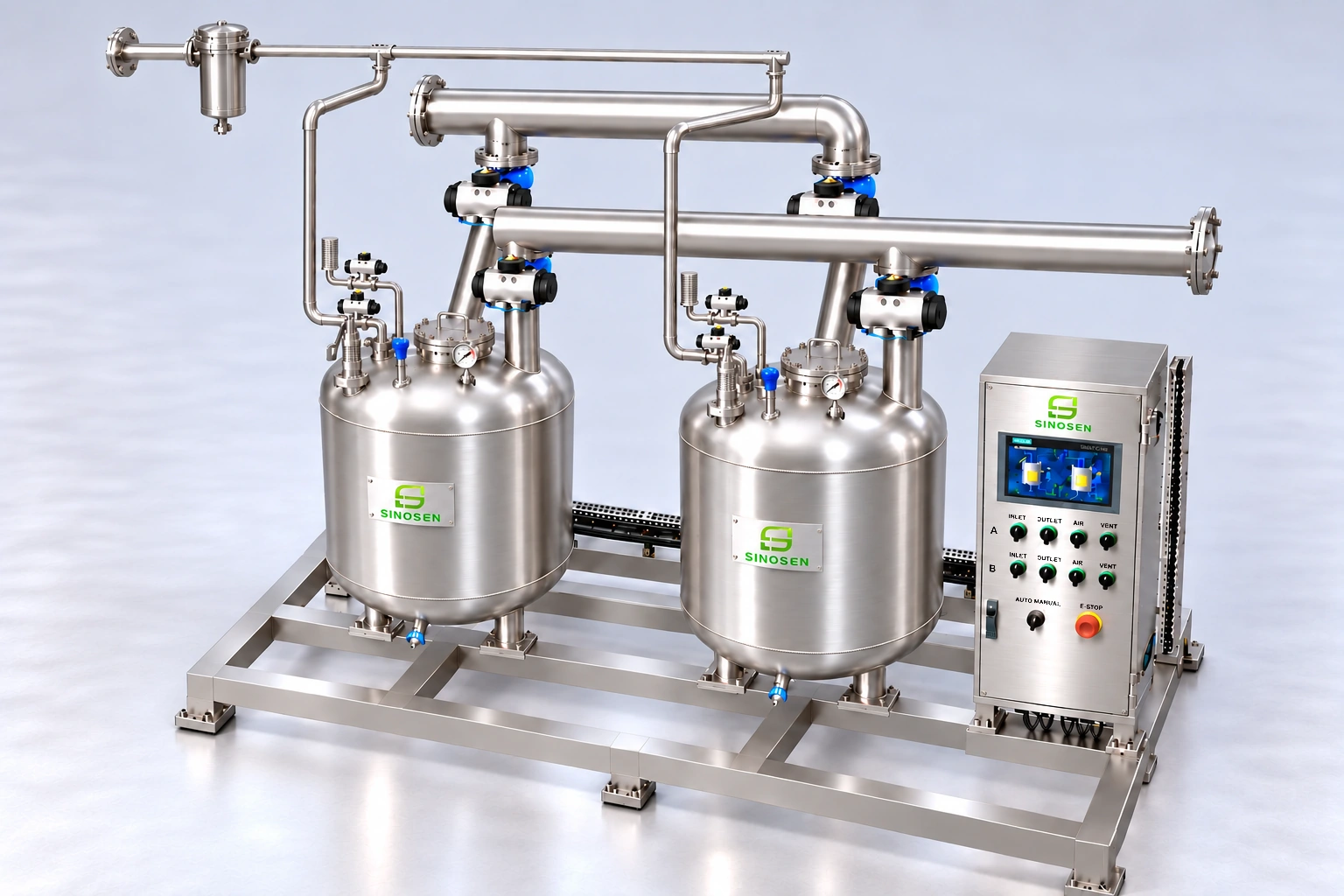
Hygienic systems
Product-contact finish, air treatment and cleaning provisions specified for the hygienic duty.
Explore the solutionBy material

Compare pneumatic transfer with your syrup gear or rotary pump. Assess flow variation, tank interlocks, compressed-air quality and cleaning requirements.
Specify syrup concentration and temperature, the required average transfer rate and any limit on aeration. Raw, clarified and refined syrups can have different hygienic and filtration requirements.
The design review covers tank permissives, overflow prevention, vessel cleaning and the receiver arrangement. Insulation and CIP options are evaluated where the process calls for them.
| Data group | Details to provide |
|---|---|
| Product properties | Viscosity at operating temperature, density, Brix where applicable, solids or crystals, foaming and air-contact restrictions. |
| Transfer conditions | Required average and peak flow, horizontal distance, elevation, pipe diameter, bends, back pressure and receiver conditions. |
| Utilities & hygiene | Available air pressure and sustained capacity, power supply, cleaning method, material requirements and applicable site standards. |

Product-contact finish, air treatment and cleaning provisions specified for the hygienic duty.
Explore the solution↗Compare the transfer principle, maintenance profile and whole-system operating cost.
Explore the solution↗Prepare the process data for a focused technical proposal.
Explore the solution↗Replacement is application-specific. We check viscosity at operating temperature, solids, air compatibility, flow stability, pressure drop, hygiene and total compressed-air cost. Metering duties, oxygen-sensitive products and hazardous fluids need separate review.
Alternating vessels can support continuous feeding and reduce transfer interruptions. Instantaneous outlet flow is not automatically constant. Valve transitions, air supply, pipeline resistance and receiver design must be evaluated for the required flow profile.
START WITH THE DUTY
Share the current pump model, maintenance problem and operating duty. Compare a pneumatic system against your existing installation using measured process data.
